

 Cuando estos días prepárabamos el excursus a la "Elucidación de la tradición", dedicado en dos entregas (
 del.icio.us
 Digg
Digg Facebook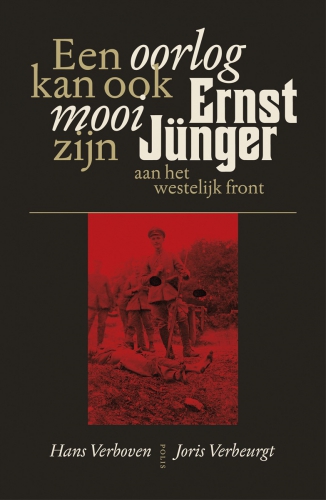
 Troy Southgate: Aveţi un “unghi spiritual”?
The following text is the transcript by V. S. of Jonathan Bowden’s last lecture, delivered at The London Forum on March 24, 2012. The original title was “Charles Maurras, Action Franҫaise, and the Cagoule,” but since he does not mention the Cagoule, I dropped it from the online version. I want to thank V. S. for transcribing a largely unlistenable audio track, and Michèle Renouf and Jez Turner for making the recording available.
French Action was largely a newspaper, but it extended out into a political movement between the First and Second World Wars and to a certain extent the second decade of the 20th century just passed, so after the first of those two wars. What made Action Franҫaise so special was the theoretical and literary contribution of Charles Maurras.
Maurras was born in Provence. He was an intellectual who was drawn to a kind of revolutionary tradition in French life. France had always been characterized until the later 19th century by a significant quadrant of the population who rejected the logic of the French Revolution. The French Revolution, which lasted from 1789 until Napoleon’s essential conquest of military power in the French Republic in 1796 and his full dictatorship in 1799 thereafter to 1815, was a period of extraordinary and grotesque change the likes of which European civilization had not seen before. Considerable parts of France, like the Vendée and elsewhere, also fought against the revolutionary tyranny of that time. These were known as the Whites, or the counter-revolutionaries. This tradition of regretting the French Revolution was part of High Catholicism and part of the deep social conservatism of sections of the bourgeoisie that existed in France throughout the existence of the Third Republic.
The Third Republic was created after the collapse of France’s military honor in 1870 when the Prussians badly defeated France in the territorial war between two major European states. The emergence and unification of Prussia on the disemboweled and disinherited torso of modern France was something the French took very much to heart. Particularly in 1871, there was a communistic uprising in Paris known as the Commune which started in a particular period and which French troops put down in an extremely bloody and savage way with the sponsorship of German arms behind them in the rear.
Now, Maurras believed totally in what he called “integral nationalism” or nationalisme intégral. This is the idea that France came first in all things. Regarded as a “Germanophobe” for most of his life, Maurras escaped death after the Second World War during the period of purification when a large number of politicians, collaborators, Vichyites, revisionists, quasi-revisionists, independently minded Right-wing intellectuals, and many people who fought in the Middle East and were involved in some way or another with the Vichy regime were put to death or were hounded from the society. The trial that Maurras had at this particular time was truncated and was laughable in terms of French statute then or since.
The Resistance was very much enamored with the prospect of guillotining Maurras, seeing him as the spiritual father of Vichy. However, there was a degree to which this was an incorrect assessment, because de Gaulle had sat at Maurras’ feet during much of his early life. The interesting thing about Maurras is that he did not just influence the French radical Right, he influenced the entire French Right and he provided all of the families of the French Right, particularly those who looked to a more Orléanist monarchical replacement, those who looked to a Bourbon monarchical replacement (this is the Republic, of course), those who looked to a Napoleonic claim, and those that wanted a different type of Right-wing republic. All of these found in Maurras’ theories sustenance for the soul.
Maurras was released from prison into a hospital in the early 1950s and died soon after. He died in a degree of disgrace, and yet there’s also a degree to which that disgrace was not complete nor did it totally fill the sky. Maurras was removed from the Académie Française, the French Academy, which is the elixir of conservative and reactional and literalist and neo-classical standings in French intellectual life, yet he was reposed by somebody who was almost identical to him given the aged and conservative conspectus of the academy.
There is a degree to which Maurras identified four enemies of the French nation as he perceived them from early on in his political career and before the creation of the Action Française movement, which was an anti-democratic movement and which never took part in parliamentary elections. We shall come on to the view that politics was primary for Maurras, unlike spirituality and religion, in a moment.
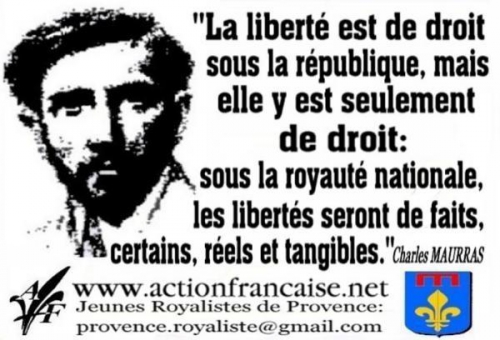
Maurras believed that these four “anti-nations” within France were Protestants, Jews, Masons, and all foreigners living on French territory. He perceived all of France as essentially sacred and universal in expectancy and energy. He believed that the Third Republic was a rotten, bourgeois counterpace that needed to be ripped down and replaced by absolutist, legitimist, and monarchical tendencies. Unlike the post-war radical Right in France which has made peace with the Republic for reasons of electoral viability, such as the Front National for example which never even intimates that it would like to restore the monarchy if it was ever put anywhere near power, Maurras and his associates were obsessed with monarchical restoration. This gave their type of Rightism a deeply reactionary and deeply counter-revolutionary cast of thought, but it is important to realize that these things were significantly popular in large areas of French national life. Large areas of the unassimilated aristocracy, the upper middle class, most of the upper class, and even parts of the essentially middle bourgeoisie, retained a suspicion of the legacy of the French Revolution and wished to see the recomposition of France along monarchical lines. These policies even lasted well into the 20th century, even beyond the Second World War. Even into the 1960s a better part of 5% of the French nation rejected the logic of the French Revolution, which is a quite extraordinary number of people given the fact that the revolutionary inheritance had lasted so long and had been re-imposed upon the country after the revolutions, themselves abortive, in 1848.
Maurras believed that France needed a strong and social Catholicism in order to be viable. This is complicated given his own tendentious hold on religious belief. Maurras, though never an atheist, rejected the early, comforting Catholicism of his childhood youth and was an agnostic for most of his life. This did not prevent him from adopting a viewpoint which was fundamentalist in relation to Catholic rigor and in the belief of what would now be called traditionalist Catholicism since the Vatican II settlement of the early 1960s, which in Catholic terms began to liberalize the Church and adapted it to a modern, secular age inside of France and beyond its borders.
Maurras believed that spirituality was intensely important for a people and without it a people rotted and became as nothing. He therefore supported radical religion as a maximalizing social agenda whilst not believing in it himself. Indeed, he implicitly distrusted much of the Gospel message and found the Old Testament disastrous in its pharisaical illumination.
Maurras believed that Christianity was a useful tool that an elite would make use of in order to create a docile, happy, contented and organic society. This means that the papacy was deeply suspicious of Maurras despite the fact that politically he seemed to be a drummer boy for what they might have been perceived to want. This led to the prorogation of the Action Française movement by the Vatican at a particular time. I believe this occurred in the 1920s and was not rescinded until 1939 by which time Maurras had been elected to the Académie Française. The Vatican was concerned at the agnosticism from the top and the synthetic use of Catholicism as a masking agent and cloaking ideology for Right-wing politics inside France that it otherwise found quite a lot to support in. There were enormous numbers of clergy in the Action Française as a movement, and they were shocked and horrified by the removal of papal support which undercut support for the Action Française from key sectors of French life at a particular time.
Maurras believed in anti-Semitism as a core element of his ideology and beliefs. He believed that Jews should have no role in national life and no role whatsoever in the sort of France which he wished to see. Although they had not been responsible in any sort of way for much of the events of the French Revolution, he believed that their emancipation, as the emancipation had occurred in Germany, Britain, and elsewhere during the 19th century, had led to a collusion of interests which were detrimental to the sacred nature of France.
He was also strongly anti-Protestant and anti-Masonic and had a view of nationality which is regarded almost as simple-minded today. He basically thought that to command a status within the French nation you had to be French in word, in deed, and in prior cultural inheritance. It wasn’t any good to claim that you were French. You had to be French in terms of the self-limiting definitions of what it was to be national. This meant that there were radiating hierarchies within France as within other European societies inside modernity. This was the idea that some people were more French than others and this implicit elitism was always part and parcel of the nature of his movement.
It’s important to realize that there was an intellectual complexity about French Action which commands a considerable degree of respect, especially from a distance. French Action appealed to an enormous number of intellectuals across the spectrum even though it was sold by quasi-paramilitaries in the street. The youth wing and the radical wings of the Action Française movement were known as the Knights of the King, Camelots du Roi, and they sold these publications in the streets, often engaging in ferocious fights with Left-wing street gangs who attempted to crowd the same pitches, particularly in Montmartre in the center of Paris and the centers of other urban areas.
Maurras believed in action in the streets as a part of politics and disprivileged voting, which he thought was sterile, bourgeois, majoritarian, and anti-elitist. One wonders if there was ever a coherent structure to come to power in the Action Française movement and the only way in which this can be corralled with the historical evidence is to see the Action Française as a [inaudible] group for a particular type of restorationist, social conservatism, and Catholicism inside France.
If Maurras’ vision had been successful, you would have had a national France with an extremely strong and powerful monarchy and an extremely strong and powerful, even hermetic Catholic clergy at the heart of the nation. You would have had strong military and other institutions that ramify with other elements of this traditional French power as expressed in Bourbon restorationist and pre-revolutionary and post-revolutionary Romantic royalist France.
Maurras believed that to be happy people had to be content in the structures of their own livery and their own inheritance. The inheritance of the French nation was all-important, and this is why he collaborated with Third Republic politicians such as General Boulanger towards the end of the 19th century. He did this in order to undermine the nature of the liberal republic and lead to reforms and authoritarian constitutions within it which would have served his purpose. He supported a large range of bourgeois, radical, and liberal politicians at the time of the First World War, which he thought was a national surprise of glory and a chance for France to redeem herself on the battlefield against a traditional enemy, which he always perceived as Germany.
This is the area where Maurras is most disprivileged by contemporary nationalist thinkers across Europe and even beyond. His obsession with Germany and with Germany’s strength and his belief that France was belittled by any strength in Germany led him to support French arms in both the First World War 1914-1918 and the Second World War 1939-1945. Initially, he supported de Gaulle and de Gaulle’s use of tank warfare in the early stages of the Second World War. Of course, by the time de Gaulle became supreme commander of French forces, France would be decimated on the battlefield and there was nothing left to repair or even to defend. Guderian, who had read all of the theory which de Gaulle had based his own warfare predictions upon, had already trumped that particular card, and the Germans used British and French ideas about tank warfare to defeat both the British Expeditionary Force and the French army in France. Seizing with revolutionary energy the generational gap in the conduct of warfare, the Germans routed and humiliated the French, who had fought them to a standstill in the past in the Great War, in a matter of weeks, by maneuvering around the Maginot Line and by passing through the allegedly impassable Ardennes Forest to appear behind French lines with roving and energetic Panzer squadrons backed by Stuka bombers.
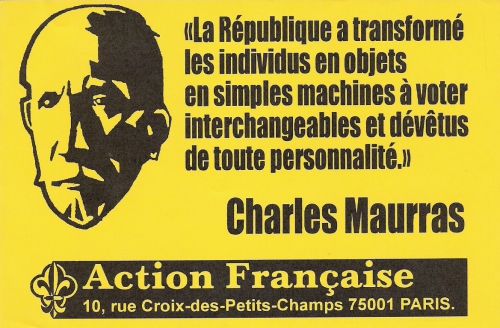
This catastrophe became a divine and a national surprise to Maurras. Maurras never actively collaborated although nearly all those in his circle would find themselves involved in the Vichy government at one time or another. Vichy began an institutionalization of a revolution from above and a national revolution within France largely permitted under German auspices, particularly in the early years before the radicalization and momentum building of what became the French Resistance under British artillery and the Gaullist movement in opposition and exile.
Maurras believed that the only true purpose of a Frenchman was to enhance the glory of France and all other was tackle and blither. He believed that during the German occupation it was best for French ideologues such as themselves to retreat to his family estate and live there in quietude even though many of his philosophical children collaborated openly with German arms both within and beyond Vichy. People like Laval and Déat with his neo-socialist movement and people like the founder of the French Popular Party, Doriot, the Parti Populaire Français (PPF) all collaborated in various degrees and were influenced by an attraction or repulsion to Maurras’ ideas in one form or another. He was truly the great old man of the French Right by this time.
After the war, the resistance sought to blame Maurras for much of the collaboration that had gone on, including the expulsion of some Jews from France, the international humiliation, as they perceived it, of French subjection to German arms, and the neo-colonial aspects within Europe of German policy in the French nation-state. It’s true to point out, however, that German military rule in France was surprisingly liberal and even benign in comparison to the full-on fury that could be exercised elsewhere in accordance with radical ideologies that had little to do with the calm, cultural intensity when Colonel Abetz met Robert Brasillach for coffee and croissants in a bar in Paris during the French occupation. There was intense collaboration between the young, former students of Maurras like Brasillach, who edited a fascist magazine called Je suis partout which means “I am everywhere,” and cultural Germans such as Abetz who were part and parcel of the German regime that had been installed over Vichy and to one side of it to allow Right-wing Frenchmen to run their own country albeit under German auspices. The relationship was probably somewhat similar to the relationship of American imperialism and its client states in the Third World such as Karzai’s regime in Afghanistan which controls Afghanistan though ultimately beholden to American power in that particular society.
Maurras wasn’t guillotined after the war because he significantly told at his trial, “Nobody hates the Germans more than me.” And this is what saved him from the guillotine, because the Resistance, although they were dying to guillotine him and would have given their eyes and teeth for it, because this gnarled, knotty Frenchman was irreducible on that point. So, they gave him life imprisonment instead which, as an old man, was effectively a death sentence in and of itself. When it was read out to him in the court, a steaming Maurras leapt from his seat and declared that, “It was the revenge of Dreyfus!” An otherwise obscure reference, which for those who are culturally knowledgeable about the entire extensive life of Maurras would have realized refers to the Dreyfus case at the end of the 19th century.
This is again an important disjunction between Maurras and much of the rest of the Right. Maurras was not concerned whether Dreyfus was guilty or not of passing secrets and engaging in espionage, of helping a foreign power, and so on. What he was concerned with is the dishonor done to the French judiciary if he was not found guilty and done to the French army and national state society if he was now to get away with this. This idea that an individual could be found guilty for connective and social-organic reasons irrespective of whether they were actually guilty of the offense one-to-one and in the customary nature of normal life is anathema to liberal ideas of the sovereignty of the individual that should be placed in a premium position in relation to all social actions.
Maurras was a fundamentalist anti-Dreyfusard and was part of a campaign spearheaded by elements of the revanchist Catholic Church and post-Boulanger elements in the French Republic to the extent that Dreyfus should be found guilty and executed if possible. For many like Maurras, the actual condemnation of Dreyfus which ensued and his being sent to Devil’s Island in the Caribbean was a minor punishment in comparison to the ingloriousness of the episode for France and what it told you about the conduct of the French national general staff at that time.
The Dreyfus case divided France between brother and brother, between father and children, between man and wife like no other case that had convulsed the nation in the course of its late 19th century/early 20th century development. It was truly one of those instances which define a generation. When Zola wrote J’accuse…! And accused the French police, army and courts of essentially fixing on an unfortunate man and blaming him for the sins of others and deporting him to Devil’s Island as a result of a false charge, he laid an explosive mound at the bottom of French national life which men like Maurras were determined to defuse.
Maurras believed that the English were always perfidious and were always against the divine France, although there were moments when he sought collaboration with English and British figures but always against the more dreaded bogey of Germany. It could be seen from a distance that Maurras’ nationalism has negative and anti-European features, although its simplicity and its purity about who belongs and who doesn’t belong is very clear and is easy to sustain. His views were not particularly racial beyond the fact that France was the leading light of world civilization and had to be treated as such. It was quite clear what he meant by who he was and who he was not, a Frenchman or a French woman, in the era in which he lived. You inherited genealogically what you were from the generations that had lived in the society prior to you and you were a Catholic and you were, to all intents and purposes, a reasonably pious one and you yearned for the return of the monarchy in France as against the secular republican institutions which replaced the monarchical structures of the Bourbon era after the Revolution and again after the Restoration which followed after the Revolution. You were not Protestant and you were not a Mason and you were not a Jew and you were not a foreigner and you were not of foreign mixture, namely of non-national French admixture. These things are quite clear and quite capacious in their reasonableness.
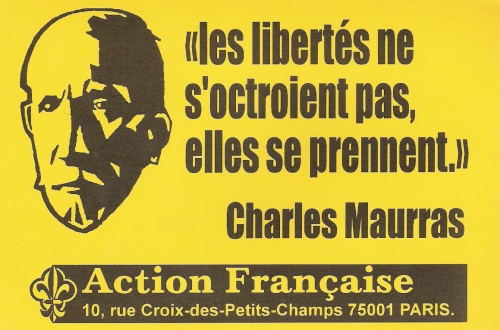
There’s a degree to which Maurras’ intense nationalism has fueled an enormous amount of the radical Right that exists in the south of Europe and the southeast of Europe and further in Central and Latin America where its ideas have been taken to heart by many Dominican, Costa Rican, Brazilian, and Argentinian nationalist writers and thinkers and academics. His thinking is also most crucial to the development of Catholic societies and, of course, he has little social interplay with the Anglo-Saxon world. Maurras seems to have little to say to Anglo-Saxony, though much to say to the integral nature of the nation which is always the defiant and unyielding France.
Where did Maurras get his opinions from? A strong bourgeois background and an affiliation with the French provinces led to an identification with the rural ideal of France as a place touched by the glory of God, even a deity that he didn’t subscribe to for much of his active life. Maurras believed that France had a new destiny amongst all of the nations on Earth not to bring people together, not to supervise people and not to be loyal to Swiss institutional ideas, as he dismissed the ideas of Rousseau, who was Swiss and strongly influenced by Calvinist and Protestant thinking which he blamed for the French Revolution.
Rousseau once declared in the first line of his social contract that in the prisons of the future men will have “Libertas,” “liberty,” stamped upon their chains. This uniquely Protestant idea whereby even the social organs of direction are there to free the individual from bondage. It’s a notable instant where in Louisiana, in the southern state of the United States, the steel batons that American police use for riot control have “liberty” inscribed upon the baton. This means that there’s the head of a rioter being broken by a riot policeman. You are being beaten over the head with freedom. You are being beaten into freedom! And this uniquely, sort of sado-masochistic and ultra-Protestant view whereby you are being punished in freedom, for freedom, by freedom is a uniquely American take upon the French Revolution. Indeed, handcuffs wielded by many American police forces have “freedom” written upon them. So, as you are handcuffed and beaten you are receiving both liberty and freedom. These are very important ideas which come from the French Revolution.
When you stand before a French court you have to prove your innocence. As everybody knows, the British idea, which transcends the Atlantic and is visible in the jurisprudence of the United States, is that you are innocent before the bar of the courts and you have various barristers there to defend your rights. In France, the opposite is true. In accordance with revolutionary jurisprudence, the state knows best. The state has divulged religiosity to itself. The state is the residual legatee of all ideas of liberty and dispassionate justice. You have to prove your innocence to the state, because if the state argues in a prior way for the possibility of your guilt you must be guilty of something or why else would the state dare to accuse you.
Maurras’ ideas come quite close to certain Anglo-Saxon ideas in his rejection of this idea of the martial, republican and even Protestant French republican state. This means that Maurras seeks help from German and English intellectual critics even as he is unmasking French intellectual culture for its support and tolerance of the French Revolution.
The French Revolution remains the most cardinal event in history as regards the modern history of France. The French Revolution characterized an enormous range of change in European society and in the lifestyle of European man. If you remember, the revolution had quite timid beginnings with the desire for bourgeois reformism and the integration of politicians like Mirabeau in 1789. It then morphed into a more legalistic liberal assembly with a legislative assembly in 1790-1791 which then became the much more revolutionary Convention in 1792-1794. This is the period associated with the Terror and the dominion of Maximilien Robespierre. Robespierre had his rival, Danton, who he sent successfully to the guillotine, but he only preceded him by a matter of a few months, was convulsed by the idea that he was imposing with revolutionary violence the implementation of justice upon France and that he’d been given the right to do so not by God but by a new-fangled Deist cult or religion called the Cult of the Supreme Being. This attempt is the height of the Revolution’s attempt to replace Catholicism with an atheistic cult, whereby reason was worshipped as a goddess and a naked virgin was placed in the [inaudible] with a liberty cap on the high altar in Notre Dame by French revolutionary Jacobins, deeply shocked the sensibility of Catholic France that it had never forgiven Paris for its revolutionary energies which were disliked by much of the rest of society.
For much of French history, Paris had always been the center of revolution even though the French revolutionary anthem, La Marseillaise, came from Marseille to Paris in order to save revolutionary Paris by adding fuel from the most revolutionary and violent part of the provinces who were then fighting against the Whites, or the counter-revolutionaries, as they came to be known.
Napoleon Bonaparte was an equivocal figure for Maurras. He liked the authoritarianism, he liked the glorification of France, but he also saw the extension of French imperialism under Bonaparte’s agency to be anti-French and to ultimately portend to national dishonor. This meant that there was if not a pacifist then a limit to national aggrandizement in Maurras scheme of things. If the nation was crucial to all social development, the nation had borders, and the nation had limits, and authoritarianism inevitably put constraints upon social action, which reminds people that Maurras remains a sort of radical or revolutionary conservative.
Regarded retrospectively as something of a French fascist, Maurras was never fascistic, although his conservativism contained strongly sublimated elements of fascism and quasi-fascism and certain beliefs in the corporate state and certain methodological axes which he would share with movements in Salazar’s Portugal, Mussolini’s Italy, and Franco’s Spain. All of these three regimes were endorsed by Maurras and by the Action Française. Hitler’s movement in Germany and its successful breakthrough there was in no sense endorsed. Indeed, he supported de Gaulle, and he supported mainstream Third Republican politicians who were anti-Hitler just as he supported Clemenceau in the First World War because he was anti-Kaiser.
The threat to France from Germany and the helplessness of France in the face of German military might were abiding themes for Maurras who saw the possibility of defeat on the battlefield as a moral and spiritual defeat for France, although like all quixotic and intuitive nationalists, Maurras believed that France could never be totally defeated. A political system had gone down under the Panzers, a political system had gone down under the Stuka bombers, but France itself was irrational and eternal and would always spring up again.
Initially, he supported the de Gaullist fight against the Germans. He immediately switched to Vichy and national liberation when he saw that much of what he wanted in policy terms could be instituted under German aegis. The fact that it was under German aegis caused him great psychic pain and wanton disregard. He therefore retreated to his own estates to cover the dichotomy of supporting Vichy at a distance without wishing to be seen to champion its German precursor.
Maurras lived in an era of tumultuous change and violent excess. None more so than the events of the 6th of February 1934. These events, unlike the Paris events of 1968 which have been emblazoned in world history and have counter-parts in Berkeley, California and the streets of Britain and the streets of West Germany as it then was and elsewhere throughout the Western world, have largely been forgotten and have been deliberately dropped down the memory hole, collectively and historically. Maurras, however, was deeply involved in the events of 1934 which were nothing more or less than an attempt to overthrow the French Third Republic by revolution from the Right-wing.
Riddled with scandal and approximating to extreme decay due to the economic lashings of depression from the United States and elsewhere who were beginning to humiliate the French exchequer, the radical Right decided to depose by going onto the streets the French Third Republic in early February 1934. This was awful rioting, and it was very serious and very destructive social rioting by about 100,000 demonstrators from all of the French combat action leagues that then existed in the country. These included the Action Française and the large veteran association from the First World War called Cross of Fire or Croix-de-Feu. It also involved large apolitical veterans’ organizations and smaller, more targeted Right-wing combat veterans’ leagues.
All of these movements marched on Paris and marched on the National Assembly and marched on the presidential buildings in an attempt to overthrow the Third Republic with violent revolutionary activism from the streets. It’s quite remarkable that these events have been excised from history to the degree that they have, particularly as they were to force catalytic change in French political life. Daladier’s regime, which was part of a Left front and Left coalition government collapsed and was replaced by the more general government of the Right.
One of the interesting examples of this period is the fact that, unlike today where the radical Right is shunted off to the side and all the areas of political thought including the moderate Right strive to have nothing to do with it whatsoever, in that era the radical Right infused the mainstream Right and even liberal, center Right elements of the Right were not immune to radical Right-wing ideas. This shows you that politics is about energy and about how you corral and contrast various forms of energy over time. There is no earthly reason why radical forms of opinion, as occurred in the 1960s the other way around on the Left, can’t influence more moderate, more statist, more staid, and more centric forms of opinion. It all depends upon the timing, the character of the men involved and the secondary forces which they can put into play. No one knew this better than Maurras who influenced these structured, highly controlled Right-wing mobs, which is what they essentially amounted to, in their assaults on French liberal bourgeois power at this time.
Sixteen died as a result of the rioting, and over 2,000 were injured, which is a large number of injuries to be sustained in endless fighting with French riot police and French police who turned out en masse to defend the Third Republic. Communists and socialists and trade unionists of the Left also mobilized large counter-demonstrations. Very much akin to events which occurred in Dublin in not too distant a period when there was a concertedly disconcerted attempt by the Civic Guard movement of Eoin O’Duffy to overthrow the post-IRA Fianna Fáil movement which then dominated the Irish Republic. It should be noticed that both societies had a penchant for political violence and for the rhetoric of extremism in the street and both were Roman Catholic societies unlike Britain, which existed of course halfway between these two polities.
The Right failed in both Ireland and France to replicate what had occurred in Portugal, Spain, and Italy, never mind Germany. However, the radical Right had an enormous transforming impact upon the entire Right wing which led a large element of the pre-collaborationist cabinet in the mid- to late-1930s to collaborate once the Vichy government was set up.
Vichy is always described as a regime by historians in an attempt to discredit it in relation to a proper government which is so described. Yet there is a degree to which the Vichy government had the support actively of at least a third of the French. De Gaulle, through a remarkable piece of political [inaudible] to make after the war, said that no one ever collaborated. This is after the purification, of course, which killed many thousands of those who were alleged to have done so. But the trick of saying that no one collaborated allowed the post-war generations to unite over the fact that there was a German occupation, no French collaboration except for a few purists and traitors and a Resistant movement activated from home and abroad. It was a clever and intellectual and ideological start to enable France to recover more quickly after the war and settle differences without being too hawkish or squeamish about it. But there is a degree to which it was a lie and a blatant untruth.
France bore quite a large price for its staunching of social peace after 1945. You have to remember that after 1945 there was no effective Right in France, because the whole of the Right had been allegedly discredited by collaboration. This meant that there was an enormous gap and only classic centrist, conservative movements fielded candidates against the center and Left in the immediate post-war elections.
De Gaulle, of course, was trying to capture the market for existing Right-wing opinion with his movement [inaudible]. De Gaulle had subliminally fascistic credentials for some of his policies and went back to yearnings for a hard man and a strong man to govern France with an iron hand. These go back to General Boulanger and back to the Bonapartism of the 19th century. De Gaulle’s movement with his endless personality cult and military drills and obsession with the cult of the leader certainly had strong fringe associations with the radical Right which he’d never the less repudiated and excoriated both in action and in print.
No internal warfare on the Right has been more striking than the one in France between the legacy of de Gaullist historical tradition and the legacy of collaboration. This again is to be seen in the Algerian War long after Maurras’ death in which the two wings of the French Right fight fanatically with each other. The government and the Civic Action Service movement and the Barbouzes fighting with the official French army against both the Algerian nationalists of the FNA and the ultra Right-wing Secret Army Organization or Organisation de l’armée secrete, which was formed by revolutionary members of the paratroopers and other French regiments firstly in Indo-China and then in Algeria to prevent the removal of Algeria from the French nation.
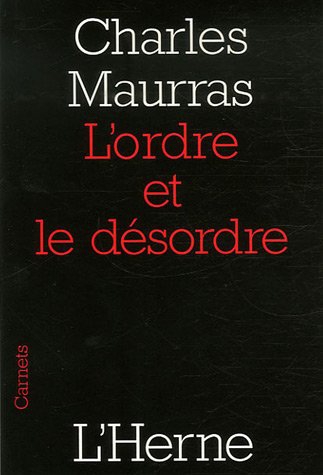 France and Algeria, of course, were joined at the hip in accordance with the Napoleonic doctrine of Algérie française. In the end, the division had to occur, but at least a million French Algerians, who were totally French of course, pieds noirs, black feet, came back from North Africa to live in the south of France where they became the bedrock for the Front National vote in the deep south of the country in generations to come.
There is also a degree to which Maurras’ influence on the French Right is pervasive, and this is the influence of social Catholicism. At every large FN event there is a ferverous mass. For those not in the know, this is a traditionalist type of Catholicism that rejects Vatican II and settlements around it in the contemporary Catholic Church. It is essentially an old-fashioned, in Protestant terms, smells and bells mass whereby the priest turns hieratically to God and doesn’t look at the congregation and the congregation look at him, or look at his back, and he’s looking up because he’s looking up at that which is exalted and beyond him. This type of social Catholicism which exists in the FN on a take-it-or-leave-it basis, because if you don’t believe in it you don’t have to go along with it, it part and parcel of their appeal to all of those national constituencies which were not buried in 1945 and were not buried in 1789 and were not buried in 1815 but have continued to exist as a vital part of the French nation and of the French national whole.
Maurras’ belief in the integral France – organic, unified, militarized, Catholicized, and hierarchical – was never achieved during his lifetime, but his influence on the French Right-wing and on neo-Bourbon, legitimist, Orléanist, and Bonapartist tendencies of opinion was profound. His influence on French military thinking was also profound, although his influence on Catholicism became strained when Catholic humanists like Jacques Maritain, who had been close to the Action Française for a considerable period, moved away from it in the 1920s. The Papacy moved against Maurras and Action Française because of his doctrine of politics first. Maurras believed that if politics was put first all the other problems that beset France and lead to spiritual difficulties could be changed retrospectively.
However, there was a degree to which this put the cart before the horse. By making himself a declared agnostic and being relatively open about this fact, he played into the hands of certain radical Catholic traditionalists who didn’t like a mass movement that used Catholicism synthetically to cover over political differences of opinion inside France.
He was also guilty of the anti-legitimist claim put forward by many deeply conservative apolitical and asocial French Catholics. This was the view that they should have nothing to do with the bourgeois Third Republic and that they should remain French and Catholic forever irrespective of a wicked regime that could not be stopped from sinning in its own right. Maurras would have nothing to do with this and believed that politics first, second, and third was necessary for the redemption of France.
The idea of monarchical restoration and a return of the French monarchy was not a quaint political ideal as far as Maurras and his immediate supporters were concerned. They believed that only by repudiating the Republic, only by ripping out the accretions of what could be described as the French version of the Bolshevik regime, namely the latter day inheritance of the French republican, revolutionary tradition and all its structures, could the France that he wanted be brought about.
Although post-war forms of the radical Right-wing in France have had to make peace with republicanism in order to survive and contest democratic elections where they have had considerable support, more so than in most other Western European countries, there is a degree to which Maurras was quite technically direct in the issue of the French republican experiment and the mass terror that it induced between 1792 and 1794 which cast the shadow of a guillotine across French revolutionary rhetoric.
Most of the great Right-wing figures, such as Abel Bonnard, look back through Maurras to the great ultramontanist figure, Joseph de Maistre. Joseph de Maistre, who wrote in the late 18th century and earlier, is responsible for the doctrine of papal infallibility up to a point at least in terms of its theoretical mark when it was introduced quite late in the day in 1870 in recognition of extra-Catholic and intra-Catholic disputes.
Maurras was determined to see Catholicism revived within France and put at the heart of the French nation, and he did residually return to the Catholicism of his childhood near to his own deathbed. Whether this was just an insurance policy or was a genuine conversion to the faith with which he had always lingered is open for his biographers to contest.
Maurras was a peppery individual with a sort of reynardical moustache and trimmed beard. He was splenetic and outrageous in debate and commentary. He called for the assassination of many public figures from the editorial mouthpiece of his magazine for which he was given many suspended sentences. When a French politician argued that all of the Right-wing combat leagues should be disarmed in France because he saw the danger of the events of 1934, Maurras called for his assassination in print, which as the calling for an execution of a government minister he was jailed 8 months for his transgression.
Maurras was never afraid to speak his mind about any of the problems that beset France from the Dreyfus case through to the French armies in the First World War to the conduct of the Treaty of Versailles. He also wanted France to impose more rigorous and more judgmental and more harsh and caustic sanctions on Germany, long considered by most historians to be a disastrous maneuver. But there is nothing in relation to what it is to be French beyond which Charles Maurras would not go.
Maurras saw himself as the quiet leader of a counter-revolutionary force in French life that would lead to the institution of an integral nation and an integral nationality above sectional interests and above party interests, which he always despised. The interesting thing about his form of Frenchness is that everyone could have a role in it. All of the minorities which he effectively despised as foreigners, métèques, would actually always have a role within France. It’s just that role would be lesser proportional to who and what they are in relation to the role of the French. Ultimately, his vision was conservative. If you were more French than somebody else, you had more of a say and more of a role. If you were Catholic rather than Protestant or Jewish or something, you had more of a role in France. It is not to say the others would have no role, but they would have a severely restricted and reduced role in relation to those who would supervene over the goddess. The goddess was one of his private terms for France and for the French nation, which was always perceived as a feminine creation and identity by all of its proponents and detractors.
Charles Maurras is so French a figure that he is largely ignored in the Anglo-Saxon and Anglophone world because he’s seen to have little to teach to the rival Protestant, national, and imperial trajectories of these societies. This is arguably true. Maurras has to be seen and judged in French terms and in French terms alone.
Although he never succeeded in the most radical of his aims, part of the regime that existed under Vichy can be seen as the endorsement of many of his ideas although the resistance groups would pitch and the Allied invasion pulled back upon Vichy and led to the end of the collaboration. The irony of Maurras’ tradition and career is that the sort of France he wanted was brought about under the arms and vigilance of the nation he hated more than any other, namely the Germans. This is part of the irony of history, which would not be forgotten on somebody as literate and carefully minded as Charles Maurras.
One of the things that is most striking about Maurras is that the Action Française was read intellectually right across the spectrum. A young, homosexual Jewish author called Marcel Proust, who was later to write one of the most famous books in French literature called Remembrance of Things Past, used to literally run every Friday down to the Camelots du Roi paramilitaries who sold Action Française on the street in order to buy Action Française. When he was asked by a certain dumbfounded bohemian who had met his acquaintance why he did this, he said he did it because it was the most interesting paper in France. This is something which is key to an understanding of people like Maurras and the radical Right cultural tradition that they represented. They were admired by all sorts of people who didn’t share their opinions at all, and that was part of the elixir of their power and their cultural influence. This is why he was elected to the French Academy, the most august and antiquated of French cultural institutions.
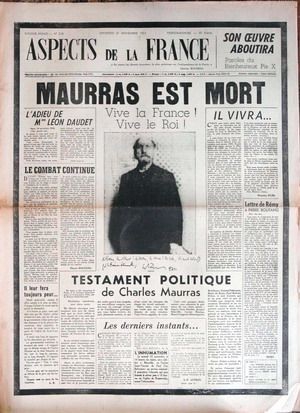 So, I think it falls upon us, as largely non-French people, to look back upon this traditionalist philosopher of the French radical Right with a degree of quiet appraisal. Maurras was a figure who could be admired as somebody who fought for his own country to the last element of his own breath. He was also somebody who’s own cultural dynamics were complicated and ingenious. To give one cogent example, the Greek play Antigone deals with the prospect of the punishment of a woman by Creon because she wishes to honor the death sacrifice of her brother. This becomes a conflict between the state and those who would seek to supplant the state’s momentary laws by laws which are regarded as matriarchal or affirmative with the chthonian or the fundamental in human life. George Steiner once commented in a book looking at the different varieties of Antigone that most critics of the Left have always supported her against Creon and most socially Right-wing commentators like T. S. Eliot have always supported Creon against Antigone. And yet Maurras supported Antigone against Creon, because she wished to bury her brother for reasons which were ancestral and chthonian and came up from under the ground and were primeval and were blood-related and were therefore more important and more profound than the laws that men had put together with pieces of parchment and bits of writing on paper.
Charles Maurras: hero of France, national collaborator with excellence, we salute you over this time, we remember your contribution to the [inaudible] of a rival nationality!
Thank you very much!


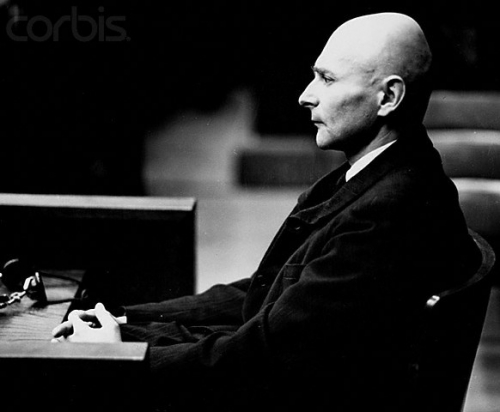
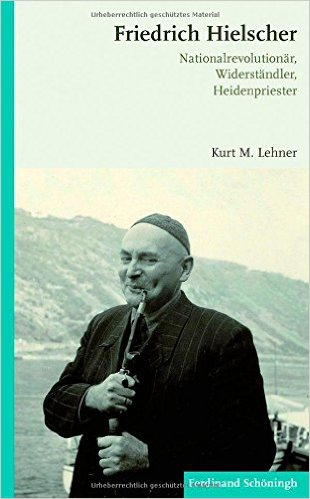 Ein dritter Blogbeitrag zu diesem Vordenker aus dem Mai 2012 ist bislang nie veröffentlicht worden. Er soll hiermit veröffentlicht werden. Inzwischen ist auch eine neue Biographie über Friedrich Hielscher erschienen: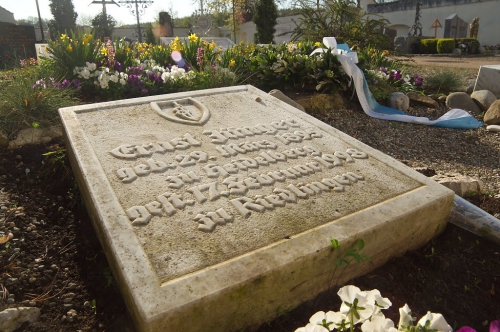
 Infatti, all’interno dell’opera

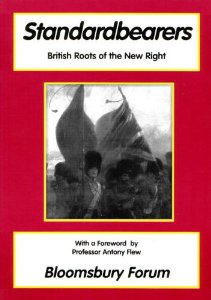
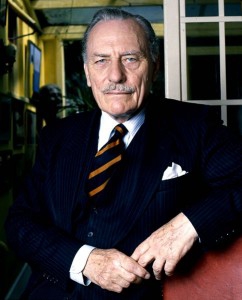 The volume at hand, Standardbearers, seems to have been assembled in the late 1990s to help forge a new middle-way Rightism. It was the early Tony Blair years. The Conservatives were in the wilderness, in thrall to Political Correctness, and the respectable Right had lost its way. Tony Blair had a way of dismissing his opponents’ arguments by describing them as “the past.” As Antony Flew describes in the Foreword: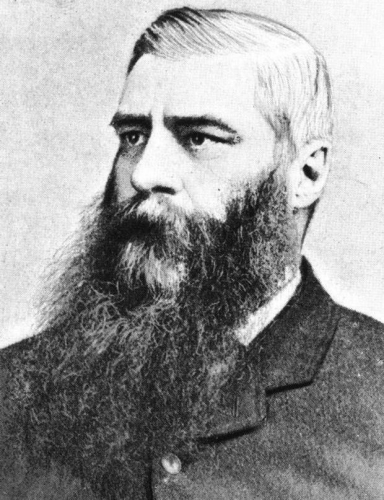
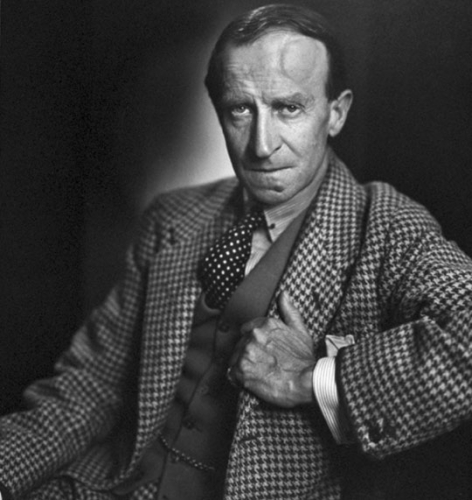
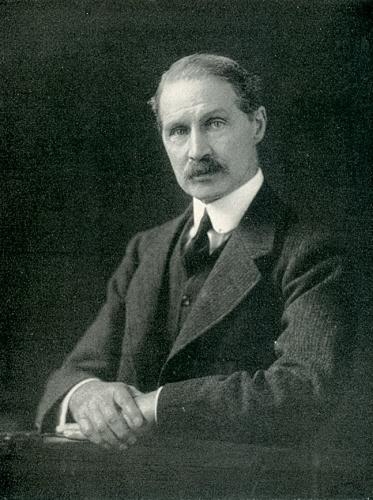
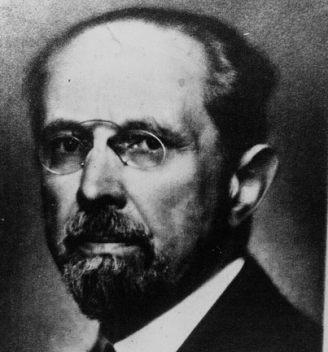
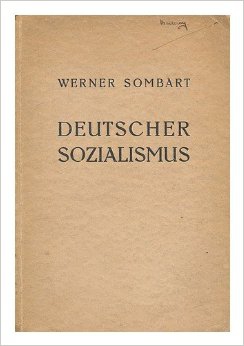 Wiewohl Sombart überhaupt den Einfluss eines säkularisierten Judentums für das Aufkommen von Kapitalismus und Sozialismus hoch anschlägt, so führt er doch nie beide kausal, d.h. schlechthin auf das Judentum zurück. Nur sei das spezifische Gepräge des modernen Kapitalismus wie des modernen Sozialismus „den Juden“ bzw. dem „jüdischen Geist“ zu verdanken, wobei Sombart übrigens letzteren – wie überhaupt alle „Volksgeister“ – von seiner leibseelischen Grundlage für ablösbar und sogar für übertragbar hält.
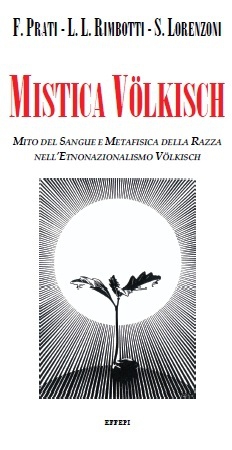 La democrazia è stata imposta all’Europa settant’anni fa con la conclusione disastrosa della seconda guerra mondiale, ma i suoi effetti deleteri hanno cominciato a diventare evidenti dopo la fine della Guerra Fredda, con la messa in atto della decisione di trasformare l’intera umanità in un’orda meticcia facilmente manovrabile dal potere dietro le quinte del sistema democratico, di recidere il legame sempre esistito e che rappresenta l’ordine normale delle cose, tra sangue e suolo.
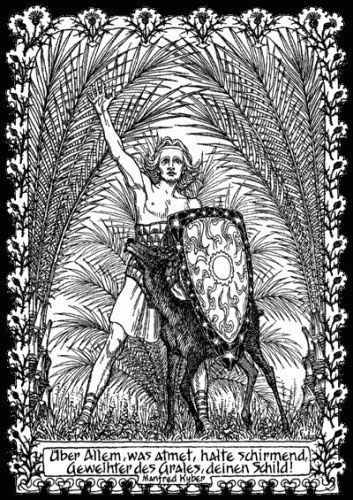 Riguardo a Evola, è importante precisare che molti hanno voluto vedere in Evola il teorico di una dottrina spirituale della razza in contrapposizione alla visione nazionalsocialista e in particolare dell’ideologo del nazionalsocialismo, Alfred Rosenberg, che si è voluta riduttivamente interpretare come un rozzo materialismo biologico. Questa interpretazione, ci assicurano i nostri autori, è completamente falsa, riesce a stare in piedi solo se si evita e si impedisca che sia accessibile la lettura di prima mano dei testi nazionalsocialisti, e in particolare del ponderoso Mito del XX secolo di Rosenberg, secondo la prassi democratica che consiste nella censura e nell’impedire il confronto delle idee, altrimenti sarebbe chiaro che il nazionalsocialismo e Rosenberg ebbero ben chiara la dimensione spirituale connessa al “mito del sangue”.
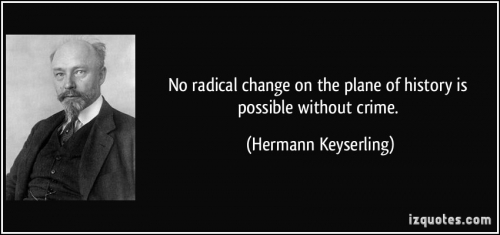
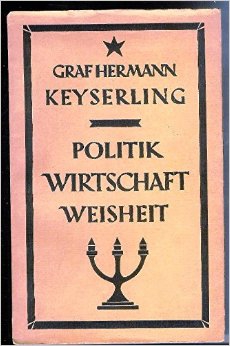 Keyserling was very pessimistic about America’s influence abroad. He believed President Wilson’s Fourteen Points “have really wrecked Europe and imperilled the position of the whole white race. They are the spiritual parents of Bolshevism because, but for the idea of the self-determination of nations and Wilson’s utter disregard of historical connexions, the Bolsheviks would never have succeeded in revolutionizing the whole East and never even dreamt of attempting the same in Europe” (p. 84).
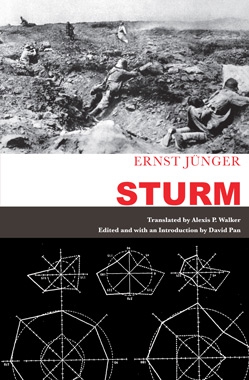
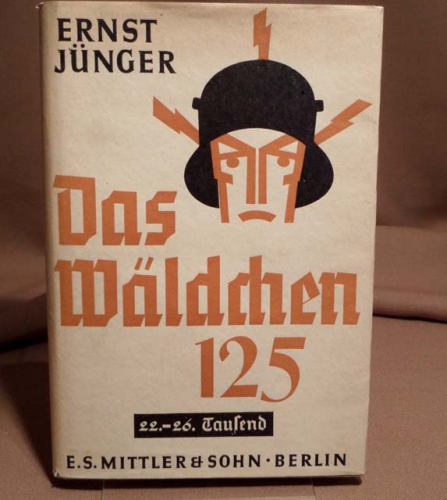
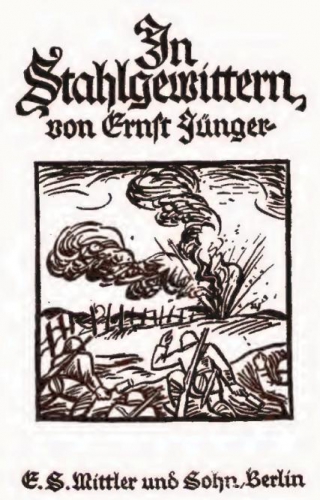 1922 erscheint Der Kampf als inneres Erlebnis und die zweite Auflage von In Stahlgewittern, 1923 im Hannoverschen Kurier in 16 Folgen die Erzählung Sturm, 1924 und 1925 Das Wäldchen 125. Eine Chronik aus den Grabenkämpfen und Feuer und Blut. Ein kleiner Ausschnitt aus einer großen Schlacht. Die erste Phase seines Werkes, in dem Jünger seine Fronterlebnisse verarbeitete, ist damit abgeschlossen. Das Jahr 1925 bedeutet für Jünger in vielerlei Hinsicht eine Zäsur. Zehn Jahre lang – bis zu den Afrikanischen Spielen von 1936 – wird Jünger keine Erzählungen und Romane veröffentlichen.
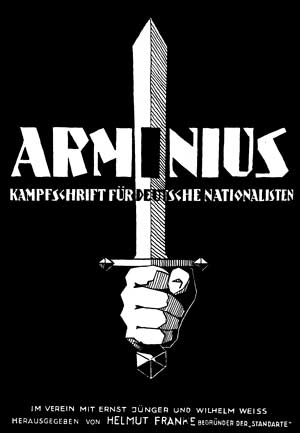 Mit dem Ende des Kaiserreichs verbindet Jünger die Überwindung einer materialistischen Naturanschauung, der individualistischen Idee allgemeiner Menschenrechte und des bloßen Strebens nach materiellem Wohlstand.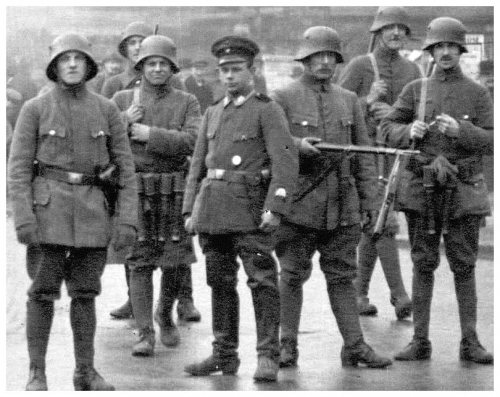
 Es sind erstens die personellen Verbindungen zu betrachten. Sie können Zeichen sein für ein gemeinsames Arbeiten an gemeinsamen Zielen, auch wenn in letzter Instanz die Ziele nicht die gleichen sind. Zweitens sind die konkreten politischen Positionen zu untersuchen und zu vergleichen. Und drittens ist nach Gemeinsamkeiten der Denkstile, der Denkfiguren, der Mentalität zu suchen.
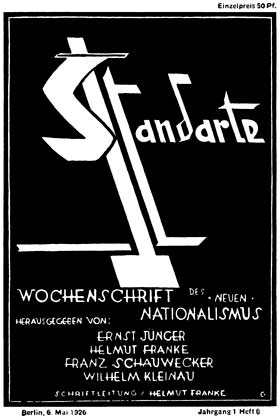 Bestimmend bleibt auch die Bedeutung der Idee: "Nach neuen Zielen verlangt unser Blut, es fordert Ideen, an denen es sich berauschen, Bewegungen, in denen es sich erschöpfen und Opfer, durch die es sich selbst verleugnen kann" (S. 196).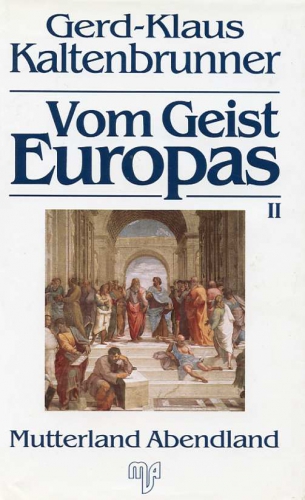
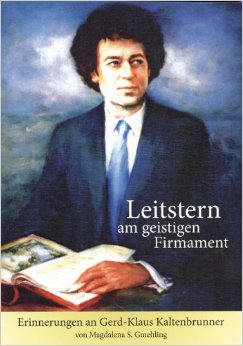 Es läßt sich mit gutem Recht fragen, welchen Sinn es hat, einen bereits über 40 Jahre alten Text wieder aufzulegen. Politische Rahmenbedingungen haben sich geändert, das entsprechende Personal wurde ausgetauscht – allein die rasante Verbreitung des Internets ab Mitte der 1990er Jahre hat Umwälzungen nach sich gezogen, die in Schwere und Ausmaß wohl tatsächlich nur mit der Erfindung des modernen Buchdrucks zu vergleichen sind.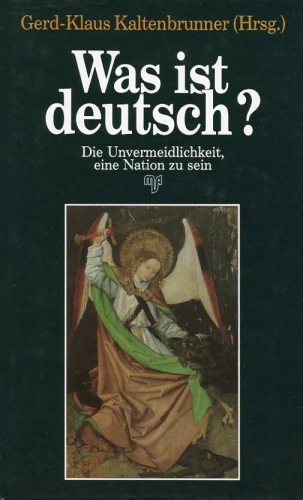
 Well, not quite. Tate, whose attitude toward Spengler is generally approving, seems to be straining at a gnat here. The answer to his question is that individual action and “organic determinism” can and do coexist. They do not contradict each other. Denizens of a high culture do not turn into a herd of mindless cattle simply because some force majeure is in operation.

 OVER THE past few years, the conviction that the end of the Cold War inaugurated an era of great-power peace to accompany the inevitable spread of democratic capitalism has been shattered. In Georgia and Ukraine, thousands have died as Washington’s attempt to fence in Russia with NATO allies and affiliates has been answered by Moscow’s determination to rebuild a Eurasian sphere of influence. In East Asia, China’s growing assertiveness has alarmed its neighbors and collided with America’s determination to remain the dominant power in the region. Regime-change efforts sponsored by the United States and its allies in Iraq, Libya and Syria have created power vacuums and bloody regional proxy wars, to the benefit of Al Qaeda and the Islamic State.
 An alternative approach, the so-called Central European approach, favors redrawing arbitrary political boundaries to create more homogeneous ethnic or linguistic groups. Neither doctrine is inherently illiberal. In his Representative Government, John Stuart Mill thus argued that liberal, representative government is most likely to succeed in countries in which most of the citizens share at least a common language, a thesis that the continuing disintegration of multiethnic states in our time would appear to confirm. In Mill’s words, “Free institutions are next to impossible in a country made up of different nationalities. Among a people without fellow-feeling, especially if they read and speak different languages, the united public opinion, necessary to the working of representative government, cannot exist.” Neither approach to defining the citizens of sovereign states equates political independence of one community from another with inherent and unremitting enmity.
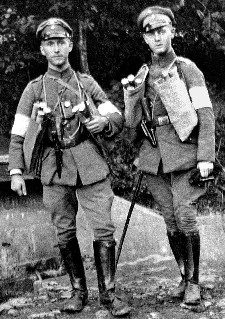 En estos artículos, que muestran la obsesiva actividad proselitista del autor, no nos encontramos con el Jünger elogiado por Hermann Hesse o H. G. Gadamer, con el ensayista profundo, el novelista imaginativo o el observador preciso, sino con el agitador político que lanza sin ambages su mensaje subversivo. No obstante, en estos escritos también se puede comprobar cierta evolución temática e intelectual. En los primeros textos se ocupa principalmente de la experiencia guerrera, del valor del sacrificio y de la sangre como cemento de una nueva sociedad, a lo que se une un profundo odio a la burguesía y a la República de Weimar. Jünger consideraba que en su generación había surgido un nuevo 'tipo humano', forjado en la guerra de material y de trincheras, a quien, a su vez, correspondía forjar un nuevo mundo: 'Como somos los auténticos, verdaderos e implacables enemigos del burgués, nos divierte su descomposición. Pero nosotros no somos burgueses, somos hijos de guerras y de enfrentamientos civiles...'. Inspirándose en Nietzsche, Spengler y Sorel, y haciendo suyo el pathos del futurismo italiano, Jünger ensalza el odio y la destrucción como elementos creativos: 'La verdadera voluntad de lucha, sin embargo, el odio verdadero, se alegra de todo lo que destruye a su contrario. La destrucción es el único instrumento que parece adecuado en las actuales circunstancias'. En estos pasajes, el escritor adopta un nihilismo heroico que convierte la violencia en un fin en sí mismo, en una experiencia mística del combatiente que debe continuar su lucha en la sociedad civil. En ellos desarrolla una estética pura de la violencia que se mueve en un vacío ético y que, supuestamente, según el autor, debería generar nuevos valores.
 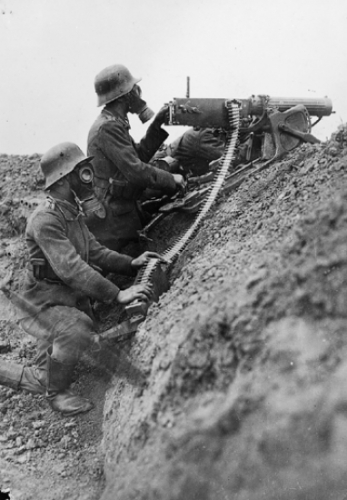 En el terreno ideológico, los artículos reflejan una visión particular y nebulosa que no llega a identificarse con ninguna de las ideologías dominantes. Sus rasgos principales son, en su vertiente negativa, un profundo sentimiento antidemocrático y antipacifista, así como un fuerte rechazo de las instituciones, excluyendo al ejército como encarnación de la idea prusiana. Su odio a la República de Weimar es manifiesto; una República, si bien es cierto, que se ha definido con frecuencia como la 'democracia sin demócratas' y que era el blanco favorito del desprecio de la mayoría de los intelectuales. Aunque Jünger se confiesa nacionalista, en concreto 'nacionalista de la acción', no asocia el concepto con una forma política concreta, más bien se limita a describir vagamente modelos utópicos o retóricos que encontrarán un desarrollo más maduro en su libro El trabajador. Armin Mohler empleó el término 'revolución conservadora' para explicar esta posición política, pero Jünger también se acercó al nacionalismo de izquierdas de un Niekisch e incluso colaboró en su revista Der Widerstand, prohibida con posterioridad por los nacionalsocialistas. La impresión que recibimos es que Jünger estaba obsesionado con una revolución, viniese de donde viniese, siempre que fuese nacional. En sus escritos solía dirigirse a 'los nacionalistas, los soldados del frente y los trabajadores'. Este empeño revolucionario fue el que le acercó al nacionalsocialismo en los primeros años del movimiento: 'La verdadera revolución aún no se ha producido, pero se aproxima irresistiblemente. No es ninguna reacción, sino una revolución auténtica con todos sus rasgos y sus manifestaciones; su idea es la popular, afilada hasta un extremo desconocido; su bandera es la cruz gamada; su forma de expresión, la concentración de la voluntad en un único punto: la dictadura. Sustituirá la palabra por la acción, la tinta por la sangre, la frase por el sacrificio, la pluma por la espada'.